Circadian Disruptions Among Traveling Endurance Athletes Influence In-Play Threshold Adjustments
Drew Schmid · Oct 1, 2026
Circadian Disruptions Among Traveling Endurance Athletes Influence In-Play Threshold Adjustments
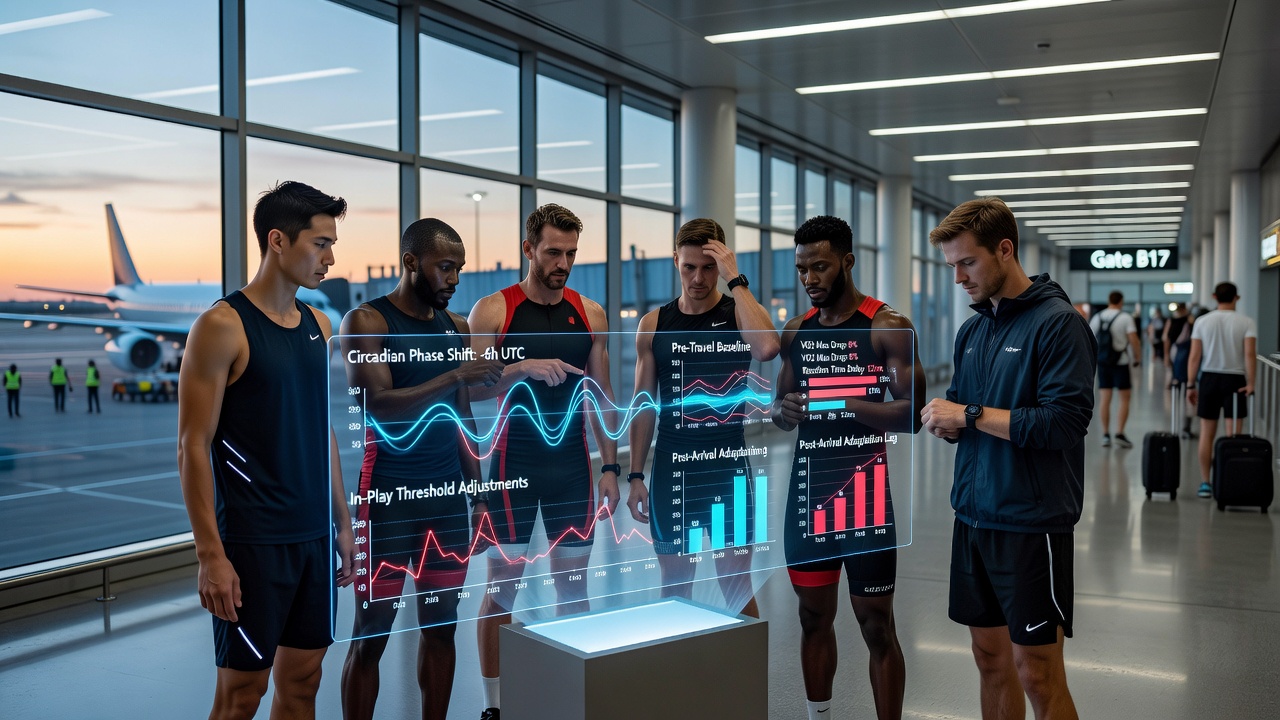
Endurance events scheduled across multiple continents create consistent patterns where athletes cross several time zones before competition, and those patterns produce measurable effects on performance metrics that betting operators track in real time. Research from sports physiology labs shows that core body temperature cycles, hormone release schedules, and sleep architecture shift when competitors move east or west rapidly, and those shifts alter expected pacing, power output, and recovery rates during long-duration contests. Operators monitoring live markets therefore recalibrate thresholds for metrics such as split times, heart-rate zones, and finishing projections to reflect the physiological state of each participant rather than baseline norms established in home time zones.
Physiological Mechanisms Behind Performance Variation
Studies conducted at research institutions across North America and Europe document how melatonin onset delays or advances depending on flight direction and time-zone difference, and those delays change muscle glycogen utilization rates along with perceived exertion levels. Data collected during multi-stage cycling tours and ultra-marathons indicate that athletes arriving from time zones eight or more hours away exhibit slower early-stage velocities followed by compressed effort windows later in the event when their internal clocks align closer to local night. Observers note that these phase shifts appear most pronounced in events lasting longer than four hours, where cumulative sleep debt compounds with ongoing activity and forces measurable departures from historical performance curves.
Adjustments to Real-Time Threshold Models
Betting platforms that integrate biometric feeds and historical race data have begun layering circadian offset variables into their algorithms, and those variables modify the acceptable range for live prop bets on metrics such as kilometer splits or power-to-weight ratios. Figures released by endurance-event organizers in 2025 and early 2026 reveal that participants traveling westward across five time zones recorded average first-half pacing reductions of 3.2 percent compared with non-traveling peers, while eastward travelers showed larger initial deficits that partially recovered after 90 minutes of competition. Modelers therefore widen the deviation bands used for in-play alerts during the opening segments of races when large numbers of competitors arrive from distant locations, then tighten those bands once the majority of the field has been active long enough for partial adaptation to occur.
Event-Specific Patterns Observed in 2026
October 2026 endurance calendars include several high-profile competitions that draw international fields, and preliminary timing data from qualifying events already demonstrate consistent differences between acclimated and non-acclimated groups. Triathlon governing bodies report that swim-to-bike transition times lengthen when athletes cross the International Date Line within 72 hours of start, and cycling federations record similar extensions in time-trial segments scheduled shortly after long-haul flights. Those recorded extensions feed directly into the threshold calculations that determine whether a live bet on overall finishing position or segment ranking falls inside or outside expected ranges.

Integration of External Research Sources
Analysts cross-reference findings from the Canadian Academy of Sport and Exercise Medicine with reports issued by the Australian Institute of Sport to refine the weighting applied to travel distance and arrival interval. Those combined datasets supply coefficients that adjust the baseline distributions used for live threshold generation, and the resulting models produce narrower confidence intervals once athletes have completed roughly 30 percent of total event distance. Operators also monitor weather and course conditions alongside circadian data because temperature and humidity interact with internal clock misalignment to amplify or dampen performance deviations.
Future Refinements in Threshold Calibration
Continued collection of wearable-derived sleep and activity logs from professional endurance circuits supports ongoing calibration of the offset tables embedded in betting systems, and those tables now incorporate individual chronotype information when available from pre-event declarations. Event medical staff in several major races have begun sharing anonymized aggregate recovery metrics with analytics teams, which allows threshold models to account for both group-level circadian effects and individual variation within traveling contingents. The approach yields more stable live lines during the middle portions of events while preserving sensitivity to late-race surges that occur when multiple athletes experience simultaneous circadian alignment with local conditions.
Conclusion
Performance records from endurance competitions held through mid-2026 confirm that circadian rhythm mismatches produce systematic, quantifiable shifts in pacing and power that operators translate into revised in-play thresholds. Integration of travel history, time-zone differentials, and biometric feedback enables continuous model updates that reflect actual physiological states rather than static assumptions. As additional longitudinal datasets become available, threshold adjustments are expected to incorporate finer chronotype distinctions and more precise arrival-to-start intervals, further aligning live market parameters with observed outcomes across global endurance calendars.